Establishing Full Books & Records Control Across All Global Reporting Regimes
Consistent control across multiple regulatory regimes for Tier 1 global bank, including EMIR, MiFIR, SFTR, ASIC, REMIT, CAT, BOI.
Improved Data Quality and Accuracy

End-to-End Control Across the Reporting Lifecycle

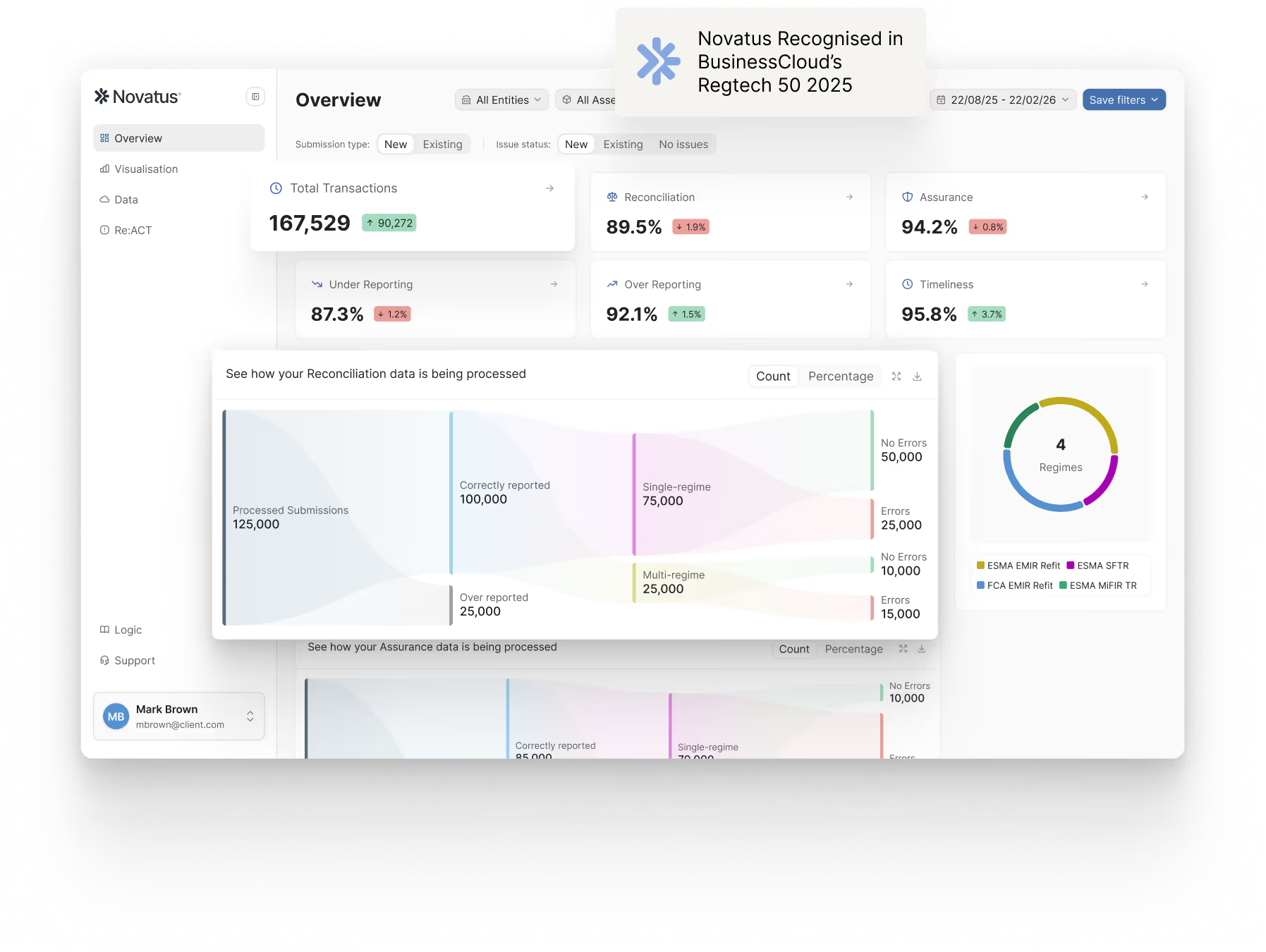
- En>ACT Diagnose
- Regimes: EMIR, MiFIR, SFTR, ASIC, REMIT, CAT, BOI
Executive Summary

A global financial institution implemented En:ACT to address a critical gap in its transaction reporting control framework: the inability to demonstrate complete, end-to-end accuracy across multiple global regulatory regimes.
Despite significant investment in reporting infrastructure, the firm lacked a consistent way to validate whether reported data fully aligned with source system books and records, and whether this could be evidenced across jurisdictions.
By deploying En:ACT, the client established a single, global control platform, delivering:
- Full Books & Records reconciliation directly from source data
- Independent validation across 100% of transactions and reportable fields
- Consistent oversight across all global reporting regimes
- Complete transparency from source system through to regulatory submission
The result was a shift from fragmented, regime-specific controls to a centralised, defensible and regulator-aligned control framework.
The Challenge
The client operated across multiple jurisdictions, including major G20 and non-G20 reporting regimes, each with distinct requirements and data structures.
This created a series of structural challenges:
- Fragmented control frameworks, with separate processes for each regulation
- Limited visibility across the full reporting lifecycle, particularly between source systems and submissions
- Inability to reconcile reported data back to underlying books and records
- Dependence on sample-based QA, leaving unknown exposure across the population
- Significant manual effort to investigate and explain discrepancies
While individual processes existed, the firm could not demonstrate consistent, global control over reporting accuracy, completeness and timeliness.
As regulatory expectations shifted towards data-driven supervision, this lack of end-to-end transparency became a material risk.
Why Traditional Approaches Failed
Legacy approaches were not designed for global, multi-regime control:
- Reconciliations were partial or regime-specific, not holistic
- QA processes focused on submission files, not underlying source data
- Validation was often retrospective and sample-based
- Data lineage across systems and transformations remained opaque
As a result, firms could identify symptoms but struggled to:
- Confirm completeness (underreporting)
- Trace errors back through transformation layers
- Prove that submissions accurately reflected their books and records
This created ongoing reliance on costly remediation programmes, rather than sustainable control.
The En:ACT Approach
En:ACT enabled the client to implement a true end-to-end control framework, spanning source systems through to regulatory reporting.
1. Full Books & Records Reconciliation from Source Data
En:ACT ingests raw data directly from source systems, including:
- Trading platforms (OMS / EMS / PMS)
- Valuation and collateral systems
- Internal reference data
It then reconciles this data against regulatory submissions to:
- Confirm all reportable transactions have been captured
- Identify overreporting and underreporting
- Validate transformation logic and derived fields
This ensures complete alignment between source systems and reported data, rather than reliance on pre-processed outputs.
2. Independent Assurance Across 100% of Data
In parallel, En:ACT performs full validation of:
- 100% of transactions
- 100% of reportable fields
Against a regulator-aligned rules framework covering all major regimes.
This provides:
- Immediate identification of data quality issues
- Consistent validation methodology globally
- Elimination of sampling risk
Replacing legacy QA models with full population, real-time assurance.
3. Single Platform Across All Global Regimes
All reporting regimes are managed within one control environment, including:
- EMIR, MiFIR, SFTR
- ASIC, MAS, CFTC
- Additional global jurisdictions
This enables:
- Consistent control standards across regions
- Reduced operational complexity
- A unified view of global reporting performance
Rather than managing fragmented, regime-specific solutions.
4. Full Data Lineage and Transparency
Every reported field can be traced:
From regulatory output → transformation logic → source system
This provides:
- Complete visibility into how data is derived
- Clear identification of where errors originate
- Direct linkage to the relevant regulatory rule
Enabling firms to move from assumed correctness to provable accuracy.
5. Root Cause Identification and Structural Remediation
En:ACT does not simply identify errors—it explains them:
- Issues categorised by type (mapping, format, missing data, etc.)
- Root causes identified across data and transformation layers
- Common issues grouped to highlight systemic weaknesses
This allows the client to:
- Implement targeted, permanent fixes
- Reduce recurrence of issues
- Transition from reactive remediation to controlled improvement
Impact Delivered
End-to-End Control Across the Reporting Lifecycle
Global Consistency and Standardisation
Improved Data Quality and Accuracy
Operational Efficiency
Enhanced Regulatory Confidence
Why En:ACT is Different
This case highlights a fundamental distinction:
En:ACT is not a reporting tool — it is a control platform.
En:ACT is the only platform that combines full books & records reconciliation with real-time assurance across all global regimes.
Conclusion
For global institutions, the challenge is no longer simply reporting—it is proving control.
By implementing En:ACT, the client moved from:
- Fragmented → Unified
- Reactive → Controlled
- Opaque → Transparent
Establishing a single, global control framework capable of:
- Ensuring accuracy, completeness and timeliness
- Demonstrating alignment to source system books and records
- Meeting the increasing demands of global regulators
The result is not just improved reporting, but sustainable, defensible regulatory control at scale.
Meet Our Experts
Novatus provides expert-led support to help clients solve their most complex challenges and continuously improve how they operate.
.png)
Ben Hall

Stephanie Rubizhevsky
.svg)
Ready to Lead. Solve. Redefine?
En>ACT Platform
Every regime. Every transaction. Every field. Anytime.
Gain real-time visibility, benchmark performance, and fix issues before they become regulatory risk.
Consulting
Transform how your organisation operates.
Solve complex regulatory, data, and operational challenges with experts who deliver outcomes, not just advice.